Best Portable Power Station for CPAP Machines in 2026: Complete Guide
Find the best portable power station for your CPAP machine. We break down exact runtimes, watt-hour requirements, and pure sine wave compatibility for ResMed, Philips, and other CPAP brands.
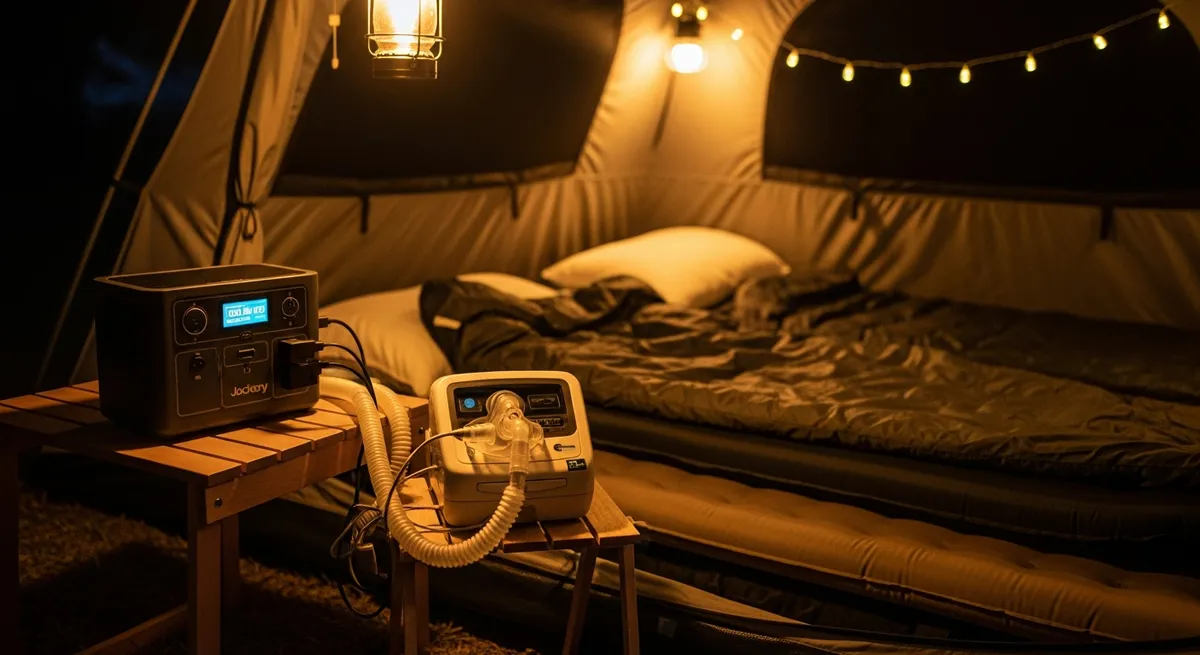
Why You Need a Dedicated Power Station for Your CPAP
If you rely on a CPAP machine for sleep apnea, losing power isn't just inconvenient — it's a health risk. Whether you're camping, traveling in an RV, or preparing for power outages, a portable power station is the safest and quietest way to keep your CPAP running all night.
But here's the catch: not every power station works with CPAP machines. You need specific features — pure sine wave output, enough watt-hours for a full night, and the right outlets. We've done the math so you don't have to.
How Many Watts Does a CPAP Machine Use?
CPAP power consumption varies significantly based on the brand, model, and whether you use a heated humidifier:
| CPAP Model | Without Humidifier | With Humidifier | Wh Per 8-Hour Night |
|---|---|---|---|
| ResMed AirSense 11 | 15-25W | 40-60W | 120-480 Wh |
| ResMed AirMini | 7-15W | N/A (no humidifier) | 56-120 Wh |
| Philips DreamStation 2 | 15-25W | 50-70W | 120-560 Wh |
| Lowenstein Prisma | 20-30W | 45-65W | 160-520 Wh |
Key takeaway: Without a heated humidifier, most CPAP machines draw only 15-25 watts. That means even a 300 Wh power station can run your CPAP for 12+ hours. With a humidifier, you'll want at least 500 Wh for a comfortable margin.
Critical Requirements for CPAP Power Stations
1. Pure Sine Wave Output (Non-Negotiable)
CPAP machines contain sensitive electronics and motors. A pure sine wave inverter produces clean AC power identical to your wall outlet. Modified sine wave inverters can cause buzzing, overheating, or even damage your CPAP. Every power station we recommend uses pure sine wave output.
2. Sufficient Watt-Hour Capacity
Use this formula: (CPAP wattage) × (hours of sleep) × 1.15 = minimum Wh needed. The 1.15 multiplier accounts for inverter efficiency losses. For a CPAP drawing 50W with humidifier over 8 hours: 50 × 8 × 1.15 = 460 Wh minimum.
3. Low-Noise Operation
You're sleeping next to this thing. Look for power stations rated under 40 dB. For reference, a whisper is about 30 dB, and a quiet library is 40 dB.
4. DC Output Option
Many CPAP machines can run on 12V or 24V DC power directly, bypassing the inverter entirely. This is more efficient (no AC conversion losses) and means your power station lasts 15-20% longer. Check if your CPAP has a DC adapter option.
Our Top 5 Picks
🏆 Best Overall: EcoFlow DELTA 2 Max
Capacity: 2,048 Wh | Output: 2,400W | Weight: 50.7 lbs | Battery: LFP | Price: ~$1,599
The DELTA 2 Max is overkill for a single CPAP — and that's exactly why we love it. With 2,048 Wh of LFP battery capacity, it will run a CPAP with humidifier (60W) for over 29 hours straight. That's 3-4 nights of sleep on a single charge.
It charges to 80% in just 43 minutes via AC+solar combined, and at 30 dB it's quieter than most CPAP machines themselves. The 3,000-cycle LFP battery means roughly 10 years of daily use.
CPAP Runtime: ~29 hours with humidifier, ~90+ hours without
Best for: Extended camping trips, multi-night backup, whole-family emergency preparedness
💰 Best Value: Jackery Explorer 300 Plus
Capacity: 288 Wh | Output: 300W | Weight: 8.27 lbs | Battery: LFP | Price: ~$299
At just 8 pounds and the size of a lunchbox, the Explorer 300 Plus is the most portable option on this list. Its 288 Wh capacity runs a CPAP without humidifier (20W) for over 12 hours — plenty for one night.
The LFP battery offers 3,000 charge cycles, and it charges from 0-80% in about 76 minutes. It also has a built-in emergency flashlight. The only catch: 288 Wh isn't enough if you use a heated humidifier at full blast.
CPAP Runtime: ~12 hours without humidifier, ~4 hours with
Best for: Weekend camping, travel, CPAP users who skip the humidifier
⚡ Best Mid-Range: Bluetti AC200L
Capacity: 2,048 Wh | Output: 2,400W | Weight: 62.4 lbs | Battery: LFP | Price: ~$849
The AC200L hits a sweet spot: massive 2,048 Wh capacity at a significantly lower price than competitors. It runs a CPAP with humidifier for ~29 hours and supports up to 1,200W solar input for off-grid recharging.
The Bluetti app lets you monitor battery status remotely — useful when you want to check remaining runtime before bed. It's heavier at 62 lbs, so it's more of a "set it and forget it" bedside unit than a grab-and-go option.
CPAP Runtime: ~29 hours with humidifier, ~90+ hours without
Best for: Home backup, RV living, budget-conscious buyers wanting maximum capacity
🏕️ Best for Travel: Anker SOLIX C300
Capacity: 288 Wh | Output: 300W | Weight: 7.7 lbs | Battery: LFP | Price: ~$249
Slightly lighter than the Jackery 300 Plus and with a competitive price, the Anker SOLIX C300 is excellent for travelers. It features 140W USB-C input for fast charging from any USB-C charger — including laptop chargers you're already carrying. At 7.7 lbs, it's one of the lightest options that can still run a CPAP all night.
CPAP Runtime: ~12 hours without humidifier
Best for: Air travel (TSA-friendly under 300 Wh), hotel backup, light camping
🏠 Best for Whole-Home Backup: EcoFlow DELTA Pro 3
Capacity: 4,096 Wh | Output: 4,000W | Weight: 114 lbs | Battery: LFP | Price: ~$3,499
If you need your CPAP to run for a week during a power outage, the DELTA Pro 3 is the answer. With 4,096 Wh (expandable to 12 kWh with extra batteries), it runs a CPAP with humidifier for over 58 hours — while also keeping your fridge and lights on.
It connects to your home's transfer switch for automatic switchover during outages. This isn't a camping solution — it's a home emergency system that happens to also power your CPAP.
CPAP Runtime: ~58 hours with humidifier (standalone), days with expansion batteries
Best for: Hurricane/storm prep, off-grid homes, medical equipment backup
CPAP Runtime Comparison Table
| Power Station | Capacity | Runtime (no humidifier, 20W) | Runtime (with humidifier, 60W) | Price | Weight |
|---|---|---|---|---|---|
| EcoFlow DELTA 2 Max | 2,048 Wh | ~89 hrs | ~29 hrs | $1,599 | 50.7 lbs |
| Bluetti AC200L | 2,048 Wh | ~89 hrs | ~29 hrs | $849 | 62.4 lbs |
| EcoFlow DELTA Pro 3 | 4,096 Wh | ~178 hrs | ~58 hrs | $3,499 | 114 lbs |
| Jackery 300 Plus | 288 Wh | ~12.5 hrs | ~4 hrs | $299 | 8.27 lbs |
| Anker SOLIX C300 | 288 Wh | ~12.5 hrs | ~4 hrs | $249 | 7.7 lbs |
Pro Tips for Using a Power Station with Your CPAP
Use DC Power When Possible
If your CPAP supports 12V or 24V DC input (most ResMed and Philips models do with an adapter), plug directly into the power station's DC port. You'll skip the DC→AC→DC conversion and get 15-20% more runtime.
Turn Off the Humidifier to Triple Your Runtime
Without a heated humidifier, most CPAPs draw only 15-25W instead of 40-70W. If you're camping and can tolerate a dry night, your power station will last 2-3x longer.
Use EPR/Pressure Relief Settings
Some CPAP machines use more power at higher pressure settings. If your doctor approves, using EPR (Expiratory Pressure Relief) can reduce average power draw.
Pre-Charge Before Bed
Run your power station to 100% before sleeping. LFP batteries are safe to store at full charge, unlike lithium-ion batteries which prefer 80%.
Frequently Asked Questions
Can I take a power station on a plane for my CPAP?
Power stations under 300 Wh (like the Jackery 300 Plus and Anker SOLIX C300) are generally TSA-approved for carry-on luggage. Larger units must be shipped separately. Always check your airline's specific policy.
Will a power station void my CPAP warranty?
No, as long as you use a pure sine wave power station. Using a modified sine wave inverter could damage your CPAP and void the warranty.
How often do I need to replace the power station battery?
LFP (LiFePO4) batteries last 3,000+ charge cycles before dropping to 80% capacity. If you use it nightly, that's roughly 8-10 years. Lithium-ion batteries typically last 500-800 cycles.
Related Guides
Not sure what size power station you need for your CPAP? Use our watt-hour sizing calculator to find the perfect match. You can also check our complete appliance power guide to see what else your power station can handle. If you're a camper, don't miss our best power stations for camping roundup.
Frequently Asked Questions
How many nights can a portable power station run a CPAP machine?
This depends on your CPAP's wattage and the battery capacity. A typical CPAP without a heated humidifier draws 30–60W. A 500Wh power station can run a standard CPAP for 2–3 nights, while a 1,000Wh unit can last 4–6 nights. Using the CPAP's DC input instead of AC can extend runtime by 20–30% by bypassing the inverter.
Can I use a portable power station with a heated humidifier on my CPAP?
Yes, but heated humidifiers significantly increase power draw — from about 30W to 80–120W. This cuts your runtime roughly in half. If battery life is critical (like camping), consider turning off the humidifier or lowering its setting. Some users use an inline HME (heat moisture exchanger) filter as an alternative that requires zero power.
Do I need a pure sine wave power station for my CPAP?
Yes, strongly recommended. CPAP machines contain sensitive motors and electronics that require clean, stable power. Pure sine wave inverters provide the same quality electricity as a wall outlet. Modified sine wave units can cause your CPAP to buzz, overheat, or malfunction, and may void your CPAP's warranty.
Can I take a portable power station on an airplane for my CPAP?
Most portable power stations exceed airline battery limits (100Wh carry-on, 160Wh with approval). However, small power banks under 100Wh are allowed. For air travel, consider a CPAP-specific battery like the Medistrom Pilot-24 Lite (97Wh) which is FAA-approved and purpose-built for CPAP travel use.
What's the best way to charge a power station while camping with my CPAP?
Solar panels are the most popular option for camping CPAP users. A 100W–200W panel can fully recharge a 500Wh power station in 3–5 hours of good sunlight, giving you another 2–3 nights of CPAP use. You can also charge from your vehicle's 12V outlet while driving to your campsite. Bring both options for maximum reliability.
Is a power station covered by insurance or FSA/HSA for CPAP use?
Portable power stations are generally not covered by health insurance as they're classified as consumer electronics, not medical devices. However, some FSA/HSA accounts may cover CPAP-specific batteries with a letter of medical necessity from your doctor. Check with your plan administrator, as policies vary widely.