How to Calculate Your Power Station Needs: Watt-Hour Guide & Sizing Calculator
Learn exactly how to size a portable power station for your needs. Our step-by-step watt-hour calculator covers camping, emergency backup, RV, and remote work setups with real device power draws.
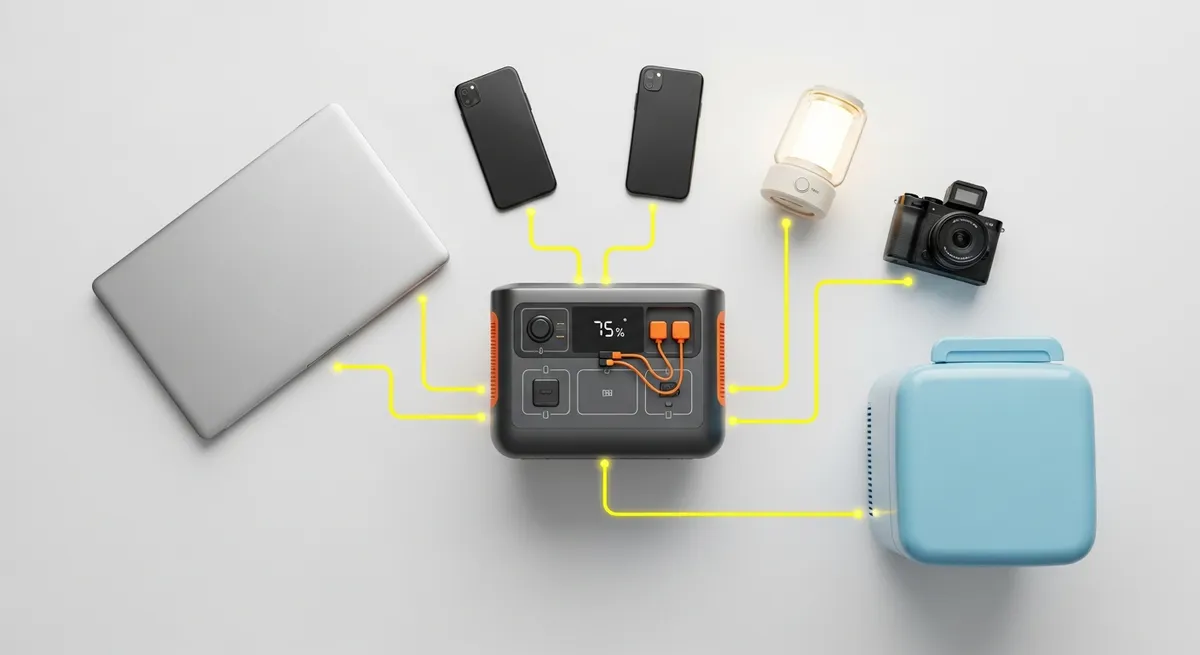
Why Getting the Right Size Matters
Buy too small and your power station dies at 2 AM. Buy too big and you've spent $1,000 more than necessary and can barely lift the thing. This guide gives you the exact math to size your power station perfectly.
The process is simple: List your devices → Find their wattage → Multiply by hours → Add a safety margin. Let's break it down.
Step 1: Understanding Watts vs Watt-Hours
These two numbers are the foundation of every power station purchase:
- Watts (W) = how much power a device uses at any given moment. A 100W lightbulb draws 100 watts continuously.
- Watt-hours (Wh) = total energy over time. A 100W lightbulb running for 3 hours uses 100 × 3 = 300 Wh.
Power stations are rated in Wh capacity (how much total energy they store) and W output (the maximum power they can deliver at once). You need both numbers to match your needs.
The Relationship
Wh = Watts × Hours
A 500 Wh power station can run a 100W device for 5 hours, a 50W device for 10 hours, or a 500W device for 1 hour. In reality, you'll get about 85-92% of the rated capacity due to inverter efficiency losses.
Step 2: Find Your Devices' Wattage
Check the label on your device, the power brick, or the manual. Here's a reference table for common devices:
| Device | Typical Wattage | Notes |
|---|---|---|
| Smartphone (charging) | 5-25W | USB, not AC |
| Laptop | 30-100W | Gaming laptops: 150-230W |
| LED Light | 5-15W | Per bulb |
| CPAP Machine | 15-70W | 15-25W without humidifier |
| Mini Fridge | 40-100W | Compressor cycles on/off |
| Full-Size Fridge | 100-200W | ~120W average when running |
| TV (40-55") | 50-120W | LED TVs on the low end |
| Electric Blanket | 50-200W | Lower on low settings |
| Coffee Maker (drip) | 600-1,200W | High draw, short duration |
| Microwave | 600-1,200W | Check actual, not "cooking watts" |
| Hair Dryer | 1,000-1,800W | Very high draw |
| Space Heater | 750-1,500W | Major battery drain |
| Window AC Unit | 500-1,500W | Startup surge can be 2-3x rated |
| Power Tools (drill) | 300-800W | Intermittent use |
| Projector | 50-300W | LED projectors much lower |
| Wi-Fi Router | 5-20W | Continuous draw |
| Camera Battery Charger | 10-30W | Low draw |
| Drone Charger | 50-100W | Per battery |
| Blender | 300-700W | Short bursts |
| Portable Fridge (12V) | 30-60W | More efficient on DC |
Step 3: Calculate Your Total Watt-Hours
Use this formula for each device:
(Device Wattage) × (Hours of Use) = Wh Required
Example: Weekend Camping Trip
| Device | Watts | Hours/Day | Wh/Day |
|---|---|---|---|
| Phone charging (×2) | 20W | 3 | 60 Wh |
| LED lantern | 10W | 5 | 50 Wh |
| Laptop | 60W | 2 | 120 Wh |
| Portable fridge | 45W | 24 | 1,080 Wh |
| Camera charger | 15W | 2 | 30 Wh |
| Daily Total | 1,340 Wh | ||
For a 2-day trip: 1,340 × 2 = 2,680 Wh needed.
Example: Emergency Home Backup (24 hours)
| Device | Watts | Hours | Wh |
|---|---|---|---|
| Refrigerator | 120W | 8 (cycles on/off) | 960 Wh |
| Wi-Fi router | 12W | 24 | 288 Wh |
| LED lights (×4) | 40W | 8 | 320 Wh |
| Phone charging (×3) | 30W | 3 | 90 Wh |
| Laptop | 60W | 4 | 240 Wh |
| CPAP machine | 50W | 8 | 400 Wh |
| 24-Hour Total | 2,298 Wh | ||
Step 4: Add the Safety Margin
Never plan to use 100% of a power station's rated capacity. Here's why:
- Inverter losses: AC output loses 8-15% efficiency in the DC→AC conversion
- Battery degradation: Capacity drops 1-2% per year
- Cold weather: Batteries perform 10-20% worse below 32°F (0°C)
- Startup surges: Fridges, ACs, and power tools draw 2-3x their rated wattage when starting
Rule of thumb: Multiply your total by 1.2 (add 20%)
From the camping example: 2,680 × 1.2 = 3,216 Wh minimum capacity needed.
Step 5: Check the Output Wattage
Capacity tells you how long. Output wattage tells you what you can run simultaneously.
Add up the wattage of everything you'll run at the same time. If your fridge (120W), laptop (60W), and lights (40W) run simultaneously, you need at least 220W continuous output.
Don't forget startup surges:
| Appliance | Running Watts | Startup Surge |
|---|---|---|
| Refrigerator | 100-200W | 400-600W |
| Window AC | 500-1,500W | 1,500-4,500W |
| Circular Saw | 1,200W | 2,400W |
| Sump Pump | 800W | 1,200-2,400W |
Quick Sizing Guide
| Use Case | Recommended Capacity | Recommended Output | Price Range |
|---|---|---|---|
| Phone + laptop charging | 200-400 Wh | 200-300W | $150-$350 |
| Weekend camping | 500-1,000 Wh | 500-1,000W | $400-$800 |
| CPAP backup (1 night) | 300-500 Wh | 300W+ | $250-$500 |
| Remote work setup | 500-1,000 Wh | 500W+ | $400-$800 |
| RV/Van life | 1,000-2,000 Wh | 1,500-2,400W | $800-$1,600 |
| Emergency home backup (24h) | 2,000-4,000 Wh | 2,000W+ | $1,200-$3,500 |
| Whole-home backup | 4,000-12,000 Wh | 3,000W+ | $2,500-$8,000 |
Common Mistakes to Avoid
1. Ignoring Inverter Efficiency
A 1,000 Wh power station doesn't deliver 1,000 Wh of usable AC power. Expect 850-920 Wh in real-world use. Always factor in the ~15% loss.
2. Forgetting Startup Surge
Your power station needs to handle the peak wattage when appliances start, not just the running wattage. A 500W-rated station will shut down if a fridge tries to start with a 600W surge.
3. Running Resistive Heating Loads
Space heaters, toasters, and hair dryers are extremely inefficient on battery power. A 1,500W space heater will drain a 2,000 Wh battery in about 1 hour. Use blankets instead.
4. Not Considering Recharge Time
If you're camping for a week, capacity alone isn't enough — you need a way to recharge. A 200W solar panel can add ~800-1,000 Wh per day in good sun. Plan your solar input to match your daily consumption.
Frequently Asked Questions
What size power station do I need for a refrigerator?
A standard fridge draws about 100-200W when the compressor runs, but it cycles on and off. Over 24 hours, expect roughly 1,000-1,500 Wh of total consumption. A 2,000 Wh power station should keep your fridge running for about 24-36 hours.
Can a portable power station run an air conditioner?
Small window AC units (5,000 BTU) draw about 500W running with a 1,500W startup surge. You need a power station with at least 1,500W output and 2,000+ Wh capacity for a few hours of cooling. It's doable but expensive and short-lived.
How many watts of solar do I need to recharge my power station?
As a rule of thumb: for every 1,000 Wh of daily consumption, you need about 250-300W of solar panels (assuming 4-5 peak sun hours). A 200W panel in good conditions produces roughly 800-1,000 Wh per day.
Put Your Calculations to Use
Now that you know your power needs, find the right unit in our roundups: what can a portable power station run, best for CPAP machines, or best for home backup.