Portable Power Station vs Gas Generator: Which Should You Choose?
Compare portable power stations vs gas generators. Detailed analysis of noise, safety, costs, and performance to help you choose the right power solution.
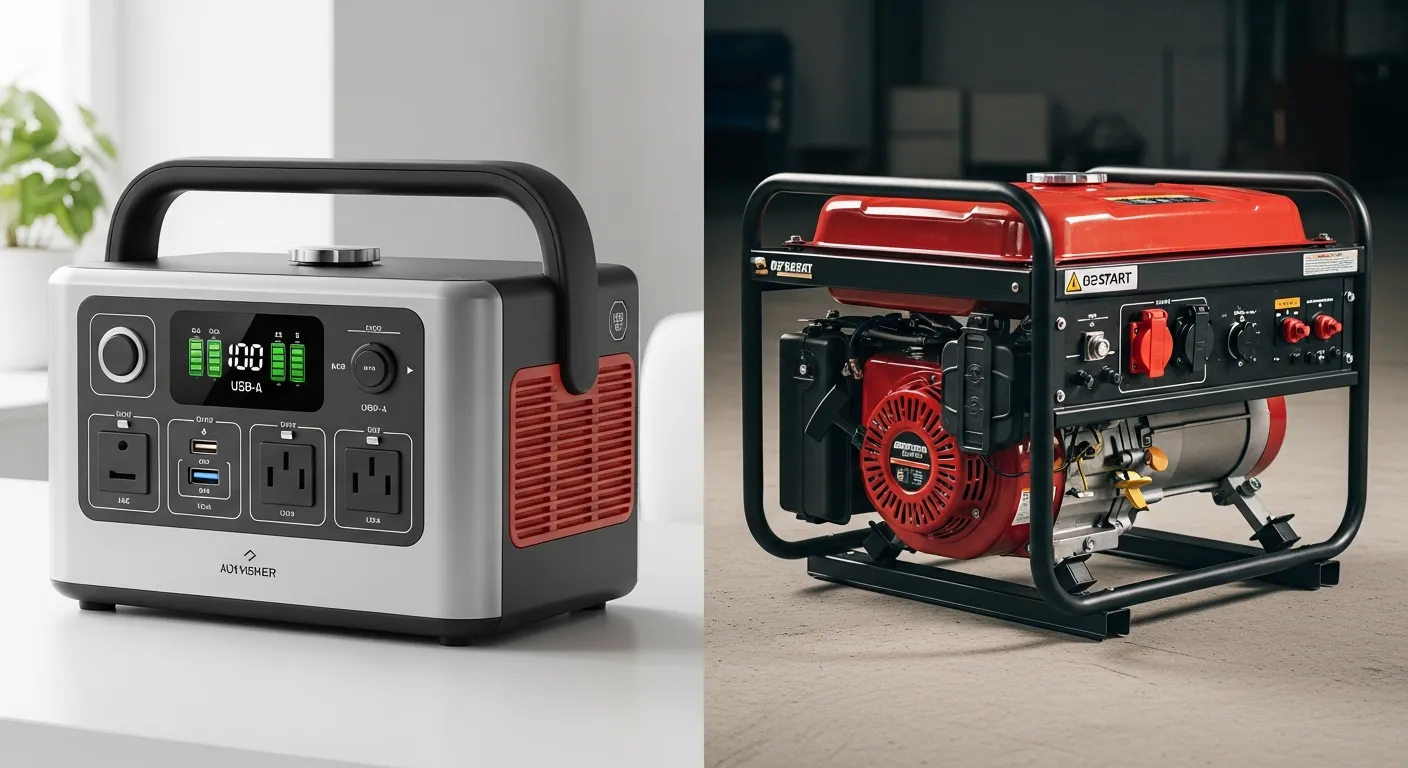
Portable Power Station vs Gas Generator: Which Should You Choose?
When you need backup power for camping, emergencies, or work sites, you'll face a critical decision: should you choose a portable power station or a gas generator? Both have their strengths and weaknesses, and the right choice depends on your specific needs, budget, and priorities.
In this comprehensive comparison, we'll examine every aspect of these two power solutions to help you make an informed decision. From initial costs to long-term value, from convenience to capacity, we'll cover it all.
Quick Decision Guide
- Choose a power station if: You prioritize silence, indoor use, zero emissions, and low maintenance
- Choose a gas generator if: You need maximum power output, longest runtime, and lowest upfront cost per watt
At a Glance: Key Differences
| Feature | Portable Power Station | Gas Generator |
|---|---|---|
| Noise Level | Silent | 60-80+ dB |
| Emissions | Zero | CO, NOx, exhaust |
| Indoor Use | Safe | Dangerous |
| Maintenance | Minimal | Regular |
| Instant Power | Yes | Pull/electric start |
| Runtime | 4-20+ hours | 8-12+ hours per tank |
| Cost per Watt | sh.8-2.0 | sh.2-0.8 |
Detailed Comparison
Noise and Disturbance
Portable Power Stations: Virtually silent operation makes them perfect for camping, residential areas, and any situation where noise matters. You can sleep next to one without disturbance.
Gas Generators: Generate 60-80+ decibels - similar to normal conversation or city traffic. Even quiet models are audible from significant distances. Many campgrounds and residential areas have noise restrictions that prohibit gas generators.
Winner: Power Stations - The silent operation is a game-changer for most users.
Environmental Impact and Safety
Portable Power Stations: Zero emissions during operation. Completely safe for indoor use, including inside tents, RVs, and homes. No risk of carbon monoxide poisoning.
Gas Generators: Produce carbon monoxide, nitrogen oxides, and other harmful emissions. Must be operated outdoors with proper ventilation. Several people die each year from generator-related carbon monoxide poisoning.
Winner: Power Stations - Safety and environmental friendliness are paramount.
Convenience and Ease of Use
Portable Power Stations:
- Instant power with the push of a button
- No fuel mixing, priming, or pull cords
- Clean operation - no spills or fumes
- Can be stored indoors safely
- Multiple charging methods (wall, car, solar)
- Digital displays show battery level and usage
Gas Generators:
- Require pull-cord or electric starting
- Need fuel mixing for 2-stroke engines
- Must be warmed up before use
- Fuel storage and handling required
- Oil changes and tune-ups needed
- Cannot be stored with fuel indoors
Winner: Power Stations - Significantly more convenient for casual users.
Power Output and Capacity
Portable Power Stations:
- Typical range: 300W to 3000W continuous output
- Higher-end models: 3000W+ with expandable batteries
- Limited by battery chemistry and cooling
- Clean sine wave power suitable for sensitive electronics
- Multiple outlet types (AC, USB, 12V)
Gas Generators:
- Wide range: 1000W to 10,000W+ available
- Higher power-to-weight ratio
- Can run indefinitely with fuel supply
- Some models produce dirty power unsuitable for electronics
- Inverter models provide clean power but cost more
Winner: Gas Generators - Better for high-power applications and extended runtime needs.
Runtime Analysis
Portable Power Stations:
- Runtime depends on battery capacity and load
- 1000Wh station: 10 hours at 100W, 2 hours at 500W
- Can be recharged from multiple sources
- Solar charging provides unlimited runtime in good weather
- Battery degrades over 2000-4000 cycles
Gas Generators:
- Runtime limited by fuel tank size
- Typical 3000W generator: 8-12 hours on 4-gallon tank
- Can refuel immediately for continuous operation
- Fuel costs add up over time
- Engine maintenance required for longevity
Winner: Depends on use case - Generators for extended runtime, stations for flexibility.
Cost Analysis
Initial Purchase Cost
Portable Power Stations:
- Entry-level (500Wh): 00-600
- Mid-range (1000Wh): 00-1200
- High-end (2000Wh+): 200-3000+
- Cost per watt-hour: sh.8-2.0
Gas Generators:
- Basic 2000W: 00-500
- Inverter 3000W: 00-1200
- High-end 5000W: 000-2500
- Cost per watt: sh.2-0.8
Operating Costs
Portable Power Stations:
- Electricity for charging: sh.10-0.30 per full charge
- Solar charging: Free after panel investment
- Battery replacement: 00-800 after 5-10 years
- No maintenance costs
Gas Generators:
- Fuel costs: -8 per day of moderate use
- Oil changes: 0-40 annually
- Spark plugs, air filters: 0-100 annually
- Engine rebuilds: 00-500 every 5-8 years
Winner: Power Stations - Lower long-term costs despite higher initial investment.
Maintenance Requirements
Portable Power Stations:
- Minimal maintenance required
- Charge every 3-6 months when stored
- Clean exterior occasionally
- Monitor battery health via app
- No mechanical wear parts
Gas Generators:
- Regular oil changes (every 50-100 hours)
- Air filter cleaning/replacement
- Spark plug replacement
- Fuel system maintenance
- Seasonal storage preparation
- Engine tune-ups
Winner: Power Stations - Virtually maintenance-free operation.
Portability and Storage
Portable Power Stations:
- Compact, suitcase-like design
- Built-in handles for easy transport
- Weight: 10-50 lbs typical
- Can be stored indoors safely
- No fuel storage concerns
- TSA-approved models for air travel
Gas Generators:
- Bulkier due to engine components
- Often require wheeled frames
- Weight: 40-150+ lbs typical
- Require outdoor storage or ventilated area
- Separate fuel storage needed
- Cannot be transported on planes
Winner: Power Stations - Superior portability and storage convenience.
Best Use Cases
Choose a Portable Power Station For:
- Camping and RVing: Silent operation won't disturb neighbors or wildlife
- Emergency home backup: Safe indoor operation during outages
- Outdoor events: Clean, quiet power for weddings, parties, or festivals
- Work from anywhere: Power laptops and equipment in remote locations
- Apartment living: Indoor-safe backup power option
- Eco-conscious users: Zero-emission power generation
- Low-maintenance preference: Set-and-forget operation
Choose a Gas Generator For:
- High-power applications: Running power tools, welders, or large appliances
- Extended outages: Multi-day power needs with fuel availability
- Remote job sites: Where noise isn't a concern and power needs are high
- Budget-conscious buyers: Lower upfront cost per watt
- Off-grid living: Continuous power generation capability
- Professional contractors: Reliable power for demanding work environments
Hybrid Solutions
Some users find success combining both technologies:
- Primary Power Station + Backup Generator: Use the station for daily needs, generator for emergencies
- Generator + Battery Charging: Run generator briefly to charge power stations, extending quiet time
- Solar + Power Station + Generator: Solar for daily charging, generator for extended cloudy periods
Future Considerations
Technology Trends:
- Battery technology improving rapidly (capacity, lifespan, cost)
- Generator emissions regulations tightening
- Solar charging becoming more efficient and affordable
- Smart features and grid integration advancing
Environmental Regulations:
- More areas restricting or banning gas generators
- Noise ordinances becoming stricter
- Push toward electrification and clean energy
Making Your Decision
Choose a Portable Power Station if you value:
- Silent operation
- Indoor safety
- Low maintenance
- Environmental friendliness
- Convenience and ease of use
- Multiple charging options
Choose a Gas Generator if you need:
- Maximum power output
- Lowest upfront cost per watt
- Extended runtime capability
- Proven technology reliability
- Professional-grade durability
- Immediate fuel availability
Recommended Models
Best Portable Power Stations
- Entry Level: Jackery Explorer 500 (00-600)
- Mid-Range: EcoFlow DELTA 2 (00-900)
- High-End: Bluetti AC300 + B300 (500-3000)
Best Gas Generators
- Budget: Champion 3500W Dual Fuel (00-500)
- Mid-Range: Honda EU3000iS (800-2000)
- High-End: Yamaha EF6300iSDE (500-3000)
Frequently Asked Questions
Can I use a power station while it's charging?
Yes, most modern power stations support pass-through charging, allowing simultaneous charging and power output. This feature makes them excellent for extending runtime with solar panels or generators.
How long do power station batteries last?
Quality power stations typically provide 2000-4000 charge cycles, representing 5-10 years of regular use. LiFePO4 batteries generally last longer than standard lithium-ion.
Are gas generators really that loud?
Yes, even quiet generators produce 58-65 dB at 20 feet, comparable to normal conversation. Standard generators can reach 70-80+ dB. This is significantly louder than the near-silent operation of power stations.
Can I charge a power station with a gas generator?
Absolutely! This is actually a popular hybrid approach - run the generator briefly to charge the power station, then enjoy hours of silent power. This maximizes the benefits of both technologies.
Which is better for emergencies?
Power stations excel for indoor emergency backup, providing immediate, safe power during outages. Generators are better for extended outages where fuel is available and outdoor operation is feasible.
Conclusion
The choice between a portable power station and gas generator ultimately depends on your priorities and use cases. Portable power stations excel in convenience, safety, environmental impact, and user experience, making them ideal for most recreational and light backup power needs.
Gas generators remain the champion for high-power applications, extended runtime, and professional use where maximum power per dollar is crucial.
For many users, the silent operation, zero emissions, and convenience of portable power stations make them the clear winner despite the higher upfront cost. As battery technology continues improving and prices decrease, power stations are becoming increasingly attractive for a wider range of applications.
Consider your specific needs: if you prioritize quiet operation, indoor safety, and low maintenance, invest in a quality portable power station. If you need maximum power output and extended runtime at the lowest cost, a gas generator might be your best bet.
Remember, you don't have to choose just one - many users successfully combine both technologies to get the best of both worlds.
Next Steps
Decided on a portable power station? Find out exactly what it can power, then use our sizing calculator to pick the right capacity. For outage prep, see our best home backup picks.